
MEGA65 Summer Filehost Roundup
MEGA65 Summer Filehost Roundup. Dan’s MEGA65 Digest for October 2026.
This month we’re celebrating four years of Dan’s MEGA65 Digest, the five year anniversary of the original MEGA65 pre-orders, and the 500th file uploaded to Filehost!
I’ve been traveling a lot in the last month, with VCF West in California and VCF Midwest in Illinois. I drove my Mini Cooper full of MEGA65 hardware all across the country, enjoying the open road and America’s best truck stop diners. I returned home to a huge stack of work that I’m still catching up on.
Meanwhile, there has been a ton of activity on MEGA65 software projects, alternate cores, and genAI experiments, so much that I haven’t been able to keep up with it. My ability to digest is strained by all of this goodness! Let’s spend this issue doing a project roundup based on recent announcements and uploads.
I have not had a chance to test all of these, so just pick what inspires you and give it a go.
MEGASPUTM now supports Zak McKracken
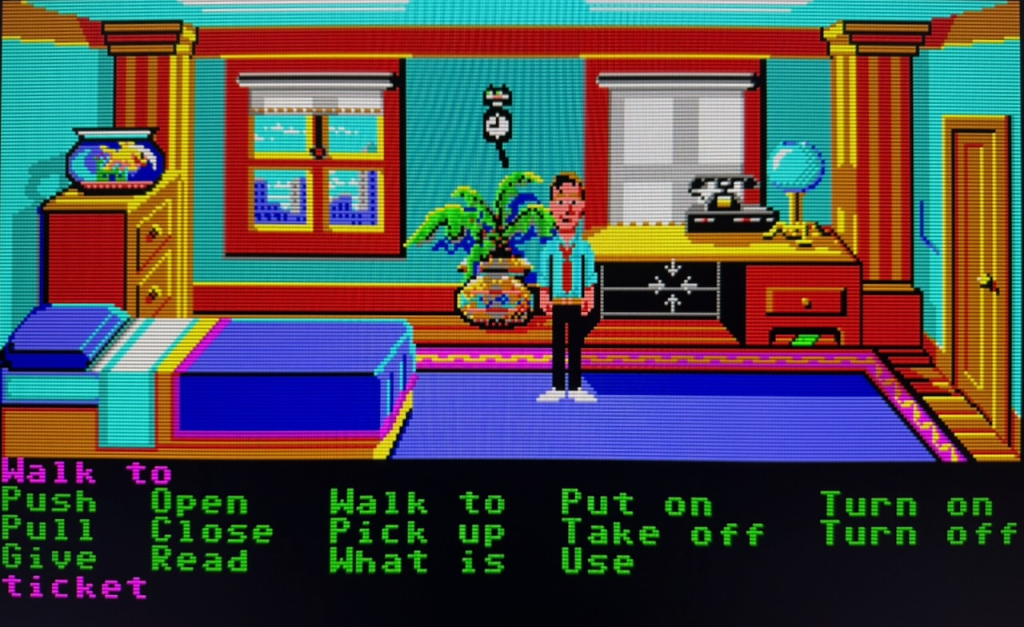
Zak McKracken and the Alien Mindbenders, running on the MEGA65.
kibo and M3wP have done it again! MEGASPUTM, their implementation of the LucasArts graphic adventure game engine for the MEGA65, can now play Zak McKracken and the Alien Mindbenders from the Amiga version’s original data files. This is a major revision above MEGASPUTM for Maniac Mansion.
See the MEGASPUTM User’s Guide for instructions on setting up the data files with the included utility program. See also the source code repo. I learned a lot from kibo’s MEGASPUTM code that informed my Digest series on developing large programs in C.
Simon the Sorcerer
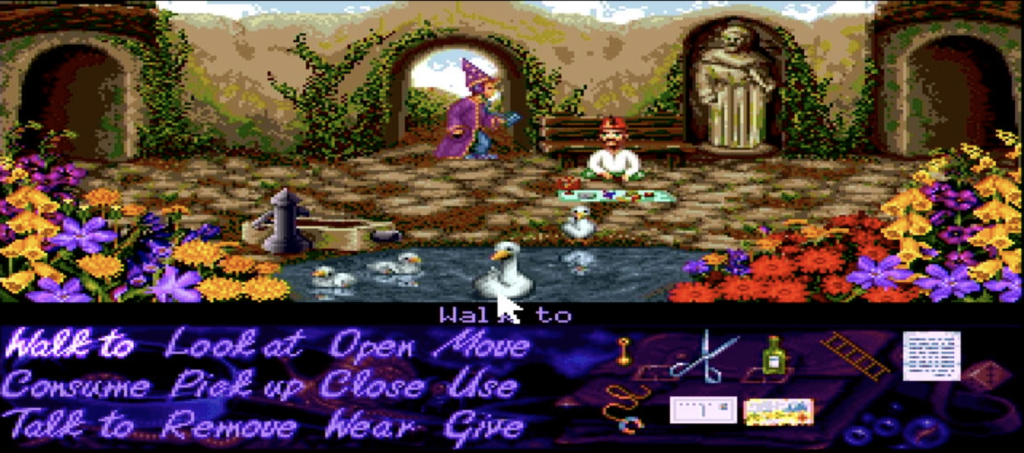
Simon the Sorcerer, running on the MEGA65.
wombat has done their own ScummVM-based graphic adventure engine port of the Amiga CD32 version of Simon the Sorcerer. Get the engine on Filehost, see the Github repo, and find the original Amiga CD32 version of the game to extract the data files.
Ozmoo for MEGA65 supports adventure games with graphics
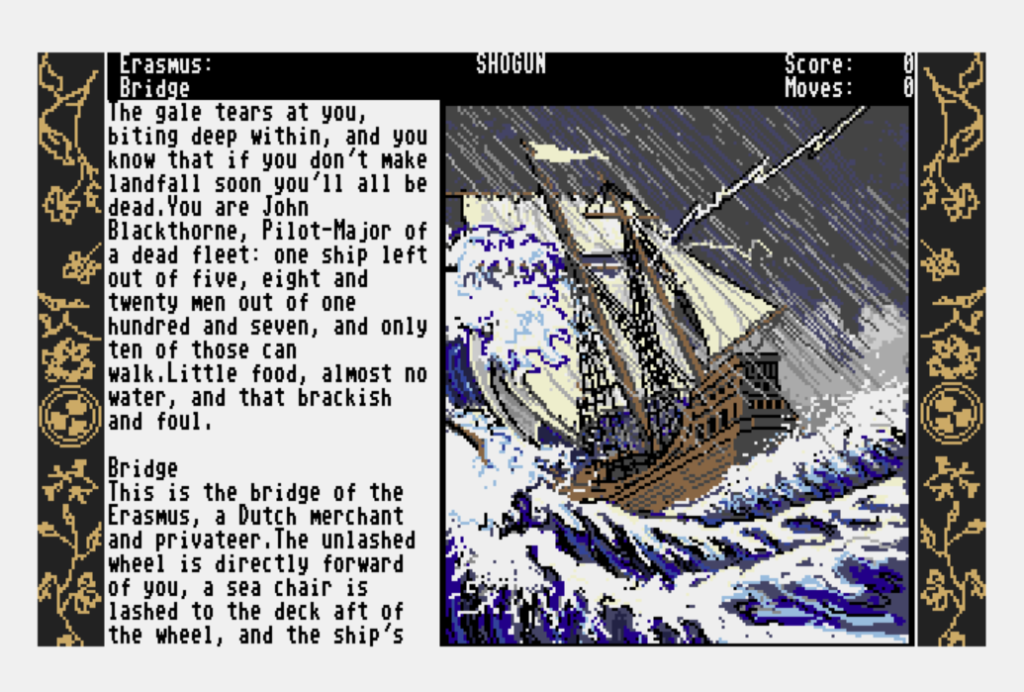
Shogun, a text adventure game with graphic by Infocom, running on Ozmoo for the MEGA65.
Infocom, the venerable makers of text adventure games in the 1980s, built all of their games on an in-house engine, retroactively named the “Z-machine.” The Z-machine evolved its game format over several versions, with most Infocom releases using versions 3 and 5. With version 6, Infocom added support for graphical images and atmospheric sound effects. (Text adventures were the subject of the October 2022 Digest.)
The MEGA65 version of Ozmoo, the modern Z-machine interpreter, now supports version 6 games. The creators of Ozmoo, Fredrik Ramsberg and Johan Berntsson, have uploaded some games for the new version, including an Infocom Z6 game bundle with Arthur, Journey, Shogun, and Zork Zero, and two original games by Johan: Wyrmward, a wizard-ing adventure, and Vanyar, a port of a game Johan wrote back in 1986.
Excited to have such a great Z-machine for the MEGA65, and to have so many great vintage and modern text games to play!
My Filehost runneth over
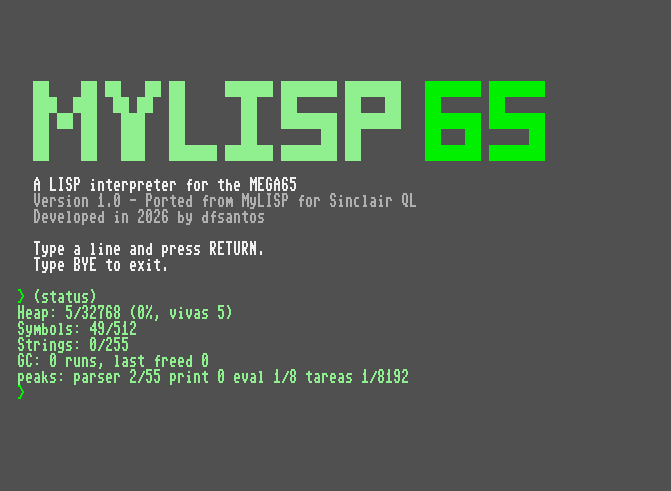
MyLISP65, a LISP-1 interpreter for the MEGA65.
The new releases keep coming! Here are more MEGA65 programs to try!
Fenix has released MyLISP65, a LISP-1 interpreter for the MEGA65. This is a port of MyLISP for the Sinclair QL, derived from a recent port of the interpreter from Pascal to C. This package includes some impressively nerdy math packages to play with. See the Github repo, as well as the Discord thread.
TwoBitRetro continues to make major improvements to Pascal65, an on-device Pascal compiler and IDE. Download the latest.
MegaPad by piramania is a featureful document editor, using a Markdown compatible file format for inline text formatting. Menus, mouse support, and characters and keyboard layouts for multiple languages.
piramania has posted several games this summer as well: Quackout, Towering Rescue, Columns 65, LeMans, Labyrinth, and MegaQix.
KnockCSV by Frogboon is a Comma Separated Values (CSV) columnar data editor.
RTC Tool by Warlock dives deep into the Real Time Clock hardware. It can set the date and time, identify and query the specific model of RTC hardware, and can even contact an NTP time server over the Internet to synchronize the clock when the MEGA65 boots.
Speaking of clocks, fredrickr has a nice BASIC Clock that displays the time, and serves as a nice BASIC coding example.
Mega Adventure Creator by NeonKnight is a toolkit for implementing adventure games in BASIC 65, with menus and NCM still graphics. Filehost, Github.
Chessoban by lochmana, is a Sokoban variant with an original concept.
dugout by bushnrvn, is a game which they describe as “A spooky baseball-themed digging game.”
Search and Rescue by johan, a voxel flight sim.
Tiwaz has been using genAI to explore the capabilities of the MEGA65, and has released eleven titles in just four weeks: GOGOAstra, a demo with music and visualization; IONDRIFT, an Asteroids-like space shooter; Rockstorm, another Asteroids-like shooter; NEON WARDEN, a platformer with a cyberpunk theme; AstraAmp, a SID player; SHIPYARD, a spaceship generator based on a small neural network; TURTLE65, a turtle graphics environment; TINYBRAIN65, a small local interactive text LLM demo that runs directly on the MEGA65; mesh65, a 3D polygon rendering demo; Space commander, a Wing Commander space battle game; and Space particles, a music and video effects demo to accompany Space commander.
Net Tools by silent-command (idiolect on Discord), a collection of Internet protocol tools, including SSH, FTP/SFTP, IRC, Gopher, and a telnet BBS client.
Cores! Cores! Cores!
The Summer of Cores continues with many core releases in the last two months, from major new projects to minor releases. I haven’t had the time to try them all, so I’ll just briefly summarize the ones the authors have mentioned in the Discord server’s announcements channel:
- Amiga 500: The Amiga 500 OCS core by sy2002 has a feature-complete version 2 beta release, with compatibility and feature improvements. sy2002 is looking to finalize the stable V2 release soon, so get your bug reports in. After V2, Kiwi will continue the project.
- Commodore 64: The C64 core from MJoergen and sy2002 has an upcoming version 6 release. Check out the alpha test release (Discord link) and try out a second virtual disk drive and both
.d64and.d81support. - Amiga 1200: Megamiga by johey is an experimental fork of the Amiga 500 core that uses the R6 mainboard’s SDRAM to expand available RAM and extend the capabilities to include Amiga 500 OCS, Amiga 600 ECS, and Amiga 1200 AGA chipsets. This version will only work with mainboards R6 and newer.
- Apple IIe: Mega//e, the Apple IIe core by muse5150 has a version 2 beta release with improved disk image support.
- Atari 800: muse’s Mega800, an Atari 800 core now has a version 1.0 alpha release.
- Black Tiger arcade: muse has released a new arcade core, Black Tiger from Capcom. See the instructions.
- Elevator Action arcade: muse has also updated the Elevator Action arcade core with a new build for both R3 and R6 mainboards. (One of my favorites, really grateful to muse for this update!)
- Sinclair QL: QL4M65, the Sinclair QL core by Fenix version 1.5 adds QXL.WIN hard drive image support. Note that v1.5 only works on R6 boards; v1.01 is still available for R3 boards.
- Amstrad CPC 6128: Fenix has started CPC4MEGA65, an Amstrad CPC 6128 core, with support for real Amstrad CPC disks in the physical floppy drive.
- Atari ST: MegaST, an Atari ST core by Chris Freeman, has special potential hardware peripheral support through the PMOD headers.
- Commodore 128: The C128 core by Stefan Eilers is up to version 1.0 beta, now with virtual drives and Caps Lock standing in for the 40/80 column key.
- BIT90: A new recreation of the BIT90 by cf23, a from-scratch recreation of a rare gem that can also run ColecoVision cartridges.
- IMSAI 8080: An experimental IMSAI 8080 core by toby01019 is an FPGA implementation of the classic computer, with an on-screen display of lights and switches, and built-in terminal.
As always, check cores.mega65.org for updated documentation on alternate cores.
Paul’s PicoPi-based core loader
So many alternate FPGA cores for the MEGA65 hardware, but only eight core flash memory slots! What is an alternate core enthusiast to do?
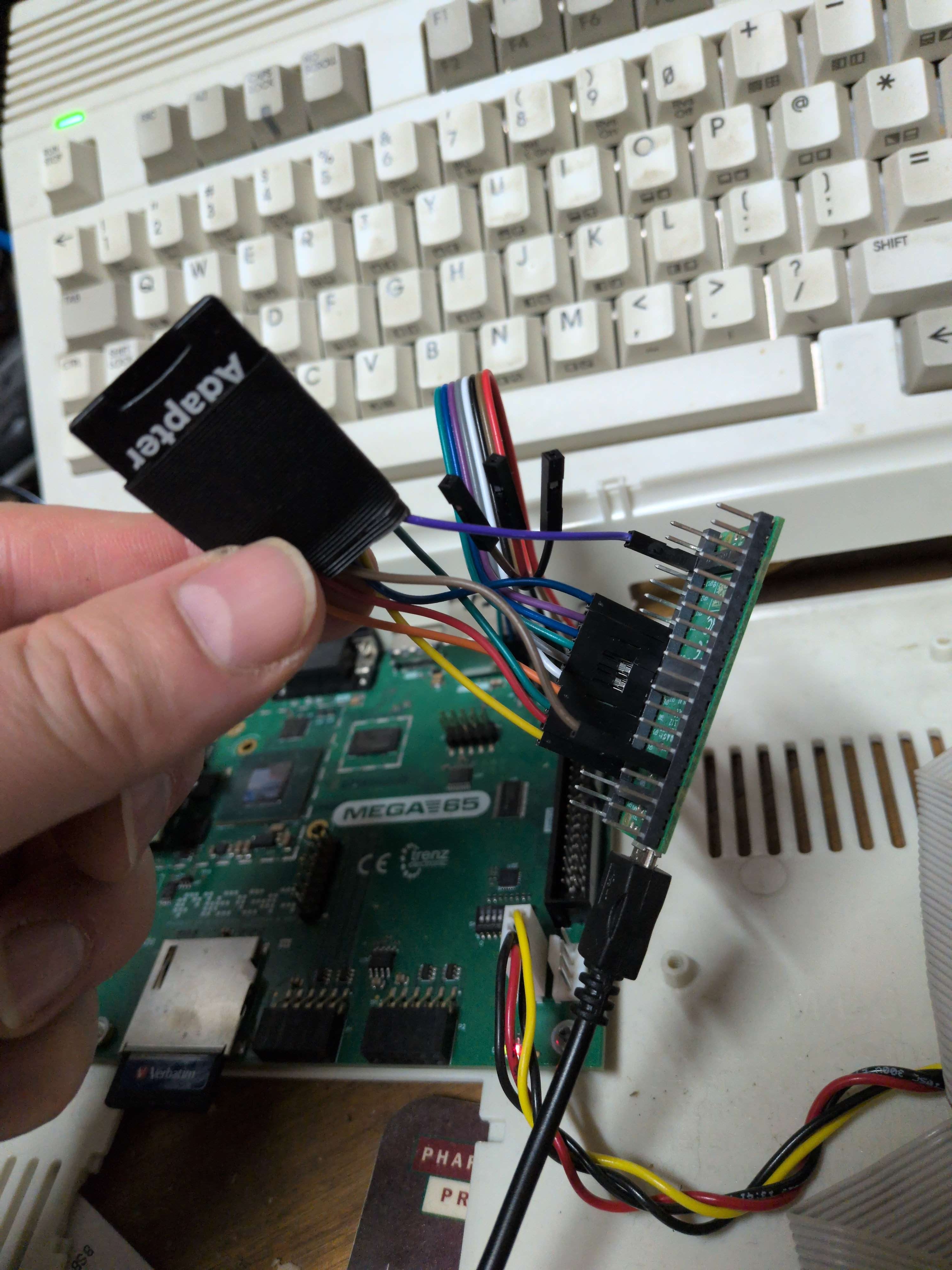
Paul has an idea: a PicoPi-based core loading device that stores MEGA65 FPGA cores on a separate SD card and loads them via the JTAG port, allowing for more core storage than the eight built-in core slots. This allows you to maintain a large core library and load them quickly and easily, without having to install them to flash memory.
The JTAG port is a set of pins on the mainboard used for FPGA cross-development. They allow another device to dump a “bitstream” directly into the FPGA, similar to how a core is loaded from flash memory during MEGA65 start-up. The connector also includes serial (UART) communication pins, so the MEGA65 can communicate with the PicoPi to browse and request bitstreams. No need for another computer to control the PicoPi, the MEGA65 can provide its own loader interface.
Fun project! See Paul’s blog for more project ideas—including recent updates on the MEGAphone mobile phone project.
That should be enough to keep us busy until the next Digest feature article. I have something half-written, and if I finish it by the end of October I’ll post it as a bonus issue.
With the increased community activity, I can no longer test and feature everything that gets uploaded to Filehost in this Digest. I’m concerned that if I try to feature every project, I might accidentally skip over someone’s hard-earned victory. (I’m certain I missed something cool just in this roundup!) So for future issues, I’m going to scale back on “Featured Files.” I will continue to post MEGA65 project news, and write feature articles and programming tutorials. I will also feature the occasional project that I think you might find inspiring for your own MEGA65 adventures.
My goal with the Digest is to get you—yes you!—interested in programming, and learning about computers, software design, game design, art, music, and all of the adjacent crafts and skills of our hobby—electronics! computer science! historical preservation!—using computing as a creative medium. Hopefully by doubling down on that focus, I can keep the workload reasonable for myself, and still offer something each month that gives you more to explore with your MEGA65.
If you’d like a more comprehensive regular rundown of all the stuff people are making, I recommend these sources:
- @mega65files is a Mastodon bot that I run that announces all new files and articles uploaded to Filehost in the MEGA65 category. You can follow it from your own fediverse app, or subscribe to the RSS feed with any feed reader.
- MEGA65 Discord: announcements channel is where many people announce their projects. We keep the channel free from chatter, as a rule, so it’s mostly a tight summary of new projects, as well as MEGA65 core project news.
- MEGA65 Discord: software-projects forum allows authors to start discussion threads for their MEGA65 software projects.
- We also have dedicated channels for the Commodore alternate cores, and a dedicated forum for other core projects.
If you have a project that you’d like to see featured here in the Digest, let me know! I’m always excited about what everyone is learning at every level, from beginners to experts. By sharing what we’re learning from our projects, we inspire others to try something new.
More soon!
— Dan